
No products in the cart.
How to Automate SEO with AI and Build a Scalable Organic Growth Engine
29
Jul
Jul
Automating search engine optimization with artificial intelligence transforms months of manual labor into a system that runs largely on its own. The core of how to automate SEO with AI lies in training tools to handle keyword research, content optimization, technical audits, and link prospecting, freeing marketers to focus on strategy. This approach eliminates repetitive tasks, reduces human error, and allows you to scale campaigns across hundreds of pages without proportional headcount growth. By the time you finish reading, you will have a concrete blueprint for integrating AI agents into every major stage of your SEO workflow.
What It Really Means to Automate SEO with AI

Many people confuse basic scripting or templated tools with true AI automation. Real automation involves systems that learn from data, adapt to changing algorithms, and make content or technical decisions without constant human input. When you understand how to automate SEO with AI, you are creating a loop where machines handle data processing, pattern recognition, and even content generation, while humans set guardrails and review outputs.
This is not about replacing SEOs. It is about removing the drudgery. Instead of spending hours pulling search volume data, clustering keywords by hand, and checking for broken links across thousands of URLs, an AI-driven stack can perform these tasks in minutes. The result is a continuous improvement cycle that would be impossible with manual effort alone.
At a technical level, automating SEO with AI relies on large language models, natural language processing, and machine learning classifiers that can mimic the judgment of an experienced strategist. These systems score content quality, predict ranking potential, and suggest internal linking structures. Modern AI platforms go beyond surface metrics and examine semantic relevance, user intent match, and topical authority.
Core Components of an AI-Powered SEO Automation Workflow
Breaking down the entire SEO function into automatable components makes the process manageable. Modern AI tools can handle each stage individually or connect them into a seamless pipeline. The following table outlines the main pillars and the AI capabilities that drive automation.
| SEO Pillar | AI Automation Capability | Example Tools |
|---|---|---|
| Keyword & Topic Research | Clustering, intent classification, trend forecasting, semantic gap analysis | SEO.AI, Clearscope, MarketMuse, Surfer SEO |
| Content Creation & Optimization | AI writing, on-page NLP scoring, real-time content scoring, entity insertion | Jasper, ChatGPT Builder, Frase, NeuronWriter |
| Technical SEO | Automated crawling, log file analysis, structured data generation, page speed monitoring | Sitebulb, JetOctopus, schema markup generators, NitroPack |
| Off-Page & Link Building | Prospect discovery, outreach personalization, unlinked mention tracking, brand monitoring | BuzzStream, Pitchbox, Respona |
| Reporting & Monitoring | Anomaly detection, rank change explanations, custom dashboard generation | Looker Studio with AI connectors, SE Ranking, Supermetrics |
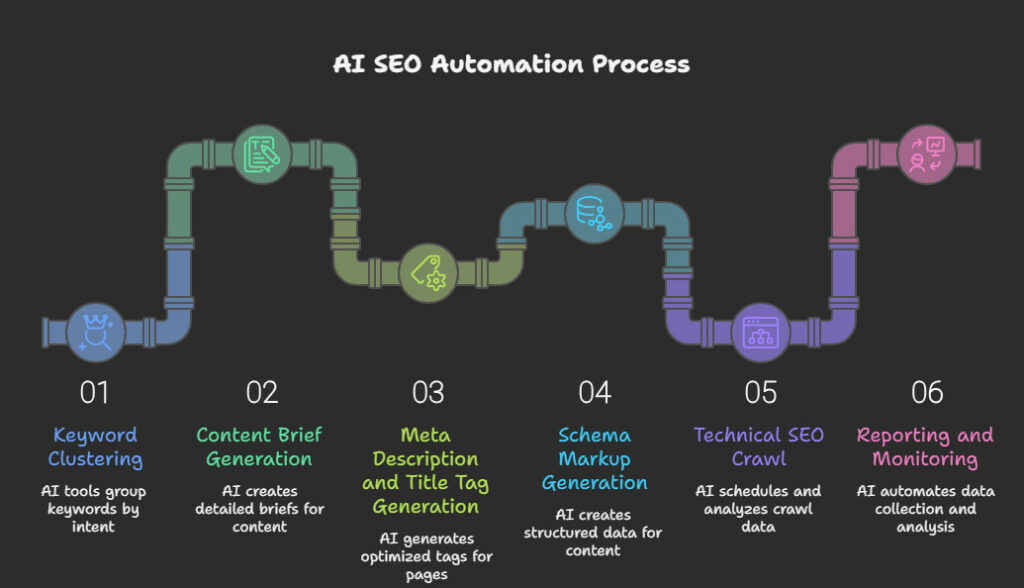
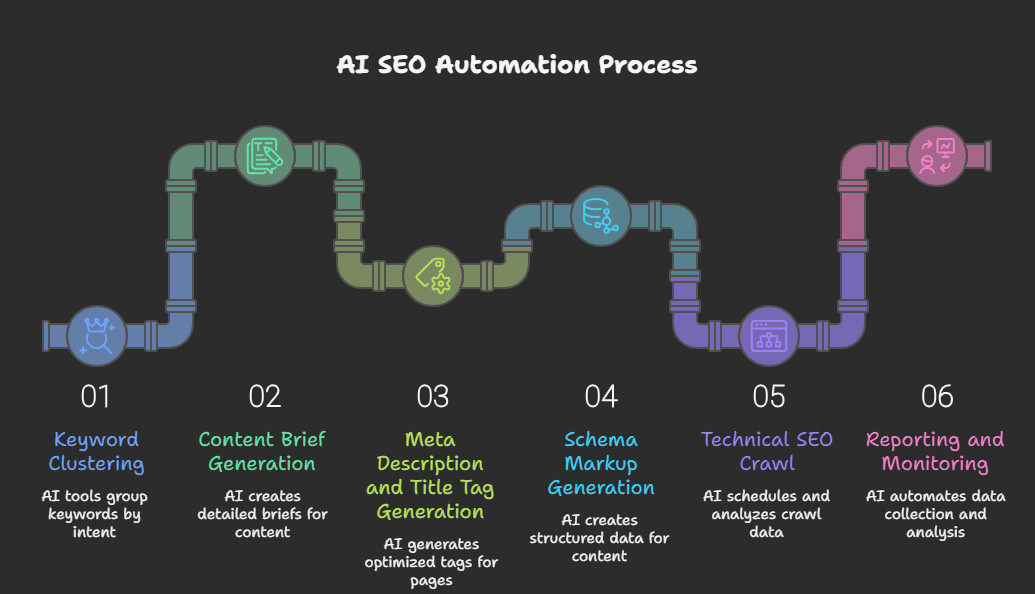
Each component feeds into the next. A topic cluster discovered by AI informs the content brief. The brief feeds into an AI writer that produces a draft scored against top-ranking competitors. After publishing, an automated crawler verifies technical health, and the performance data loops back into keyword refinement. This closed loop is the essence of how to automate SEO with AI at an enterprise level.
Step-by-Step Guide to Automating Your SEO with AI
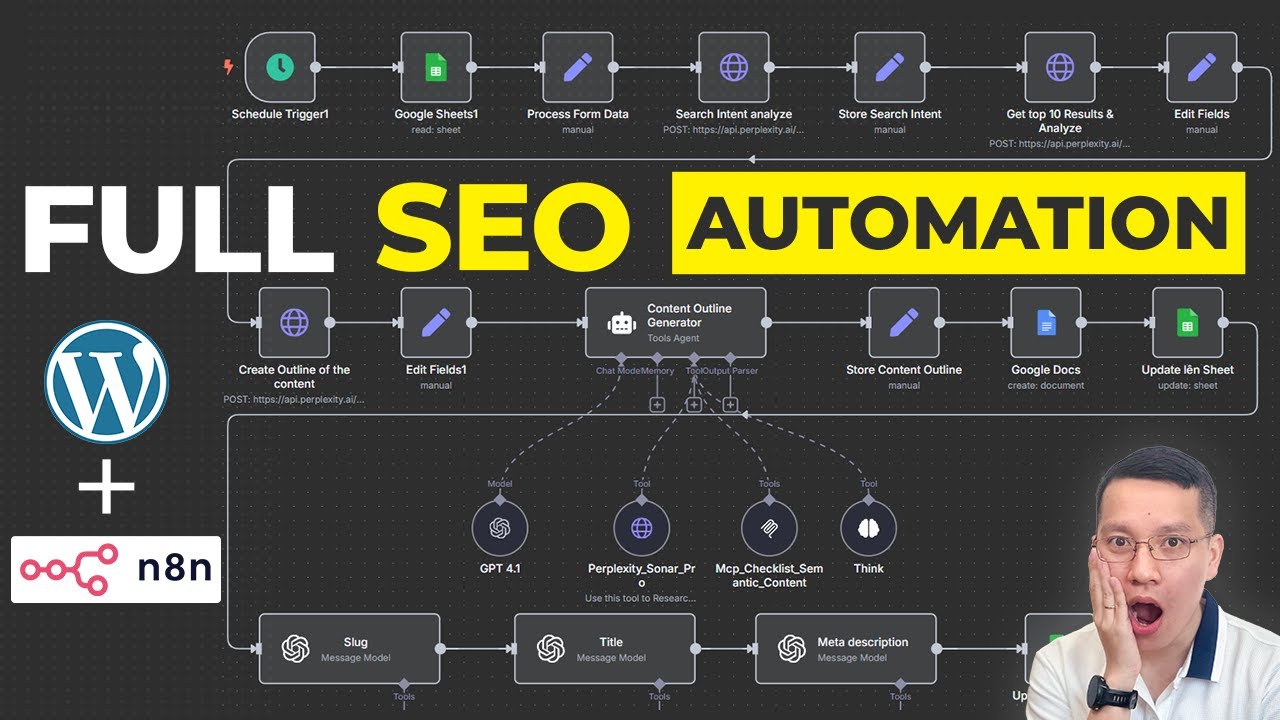
1. Building an Automated Keyword and Topic Discovery Engine
Manual keyword research is a time sink. AI changes the game by ingesting seed keywords and generating thousands of semantically related terms within seconds. Tools using large language models can cluster these terms by intent (informational, commercial, transactional) and by topical authority. The real power lies in recognizing patterns humans miss, such as rising question-based queries before they peak in traditional tools.
Start by connecting your AI tool to Search Console, Google Ads, and your CRM data. The system analyzes conversion data alongside search volume to prioritize terms that drive revenue, not just traffic. It then automatically builds content maps that assign each keyword cluster to a pillar page or supporting article. This automated prioritization avoids the common trap of chasing vanity metrics. Key steps include:
- Feed your domain and top competitors into an AI topic research tool.
- Let the model identify content gaps where competitors rank but you do not.
- Automatically group keywords by search intent and funnel stage.
- Set up weekly alerts for new long-tail opportunities your site can capture quickly.
2. Automating Content Production Without Sacrificing Quality
The most controversial aspect of how to automate SEO with AI is content creation. The fear of generic, error-filled AI content is valid, but the current generation of models, when used correctly, produces drafts that rival human writers in clarity and factual accuracy. The secret is a layered human-in-the-loop approach.
First, an AI content strategist generates a detailed brief based on the SERP analysis of the target query. It identifies the entities, headings, questions, and media types required to rank. Then, a fine-tuned writing model creates a full draft that adheres to your brand tone and E-E-A-T guidelines. You can configure the AI to inject first-party data, such as survey results or case studies, ensuring uniqueness.
After drafting, a separate AI editor scores the content against the top 20 results, suggesting improvements to headings, internal links, and entity density. Human editors only review the final flagged issues, reducing editing time by up to 80%. This hybrid model is the sweet spot for scaling content to hundreds of pages per month while maintaining rankings. The process can be further automated by hooking the AI directly into your CMS via API, so drafts appear there for review.
3. Technical SEO on Autopilot
Technical audits are perfectly suited for AI automation because they involve pattern recognition across massive datasets. An AI-powered crawler does not just list broken links; it prioritizes fixes based on traffic impact. It can detect orphan pages, thin content, and internal linking inefficiencies, then automatically generate a prioritized spreadsheet of actions.
Advanced setups use log file analysis to understand how Googlebot crawls the site. AI identifies crawl budget waste on low-value URLs and suggests robots.txt or noindex rules. Structured data markup, a critical yet tedious task, is now generated automatically by AI that understands the page’s content type. The same tools can monitor Core Web Vitals in real time and alert you before performance drops affect rankings. Implementing this means you no longer run quarterly audits; you get a living, breathing technical health monitor.
4. Intelligent Link Building and Digital PR
AI removes the guesswork from prospecting. Instead of manually searching for resource pages or competitor backlinks, an AI system scans the web for sites that link to multiple competitors but not to you. It scores these prospects based on domain authority, traffic, and relevance, then drafts personalized outreach emails that reference specific content on the prospect’s site. This personalization, once the barrier to scaling outreach, now becomes a checkbox.
Beyond classic link building, AI can monitor brand mentions across the web and automatically reach out to webmasters to convert unlinked citations into backlinks. Some platforms even predict the likelihood of a prospect linking to you based on historical response patterns, allowing you to focus energy only on the highest-probability targets. The entire workflow from discovery to follow-up gets automated inside a CRM-like interface.
5. Automated Reporting and Decision Intelligence
The final piece of how to automate SEO with AI is removing manual reporting. AI integrates data from Google Analytics 4, Search Console, rank trackers, and CRM systems into dynamic dashboards. But beyond data aggregation, it provides plain-English explanations for spikes and drops. For example, “Organic traffic to the pricing page decreased 15% because three new competitors launched aggressive content campaigns targeting your high-conversion keywords. Suggested action: refresh the comparison article and add schema markup.”
This AI-driven narrative reporting turns raw numbers into actionable strategy within seconds. Instead of spending Monday mornings building slides, you walk into meetings with insights and recommendations already drafted. This shift from reporting to strategizing is the ultimate ROI of SEO automation.
Benefits You Can Expect from AI-Driven SEO Automation
Adopting how to automate SEO with AI delivers measurable outcomes beyond time savings. The most immediate benefit is scalability. A single SEO strategist can manage a portfolio of sites that previously required a full team. Content velocity increases dramatically, allowing you to dominate topical maps before competitors react.
Another profound benefit is consistency. AI does not have an off day, does not forget to optimize a meta description, and does not miss a new technical error. Quality becomes uniform, raising the floor for your entire site. Furthermore, AI often uncovers correlations in data that humans overlook, such as a specific content structure that correlates with faster indexing or a subtle keyword modifier that signals high purchase intent.
Finally, cost efficiency improves. While AI tools require investment, the reduction in hours spent on keyword research, content drafting, and manual outreach translates to a lower cost per acquisition. For agencies, this means more profitable retainers and the ability to offer premium, data-rich services. For in-house teams, headcount can be redirected to creative and strategic work that genuinely requires human ingenuity.
Critical Limitations and Risks When Automating SEO
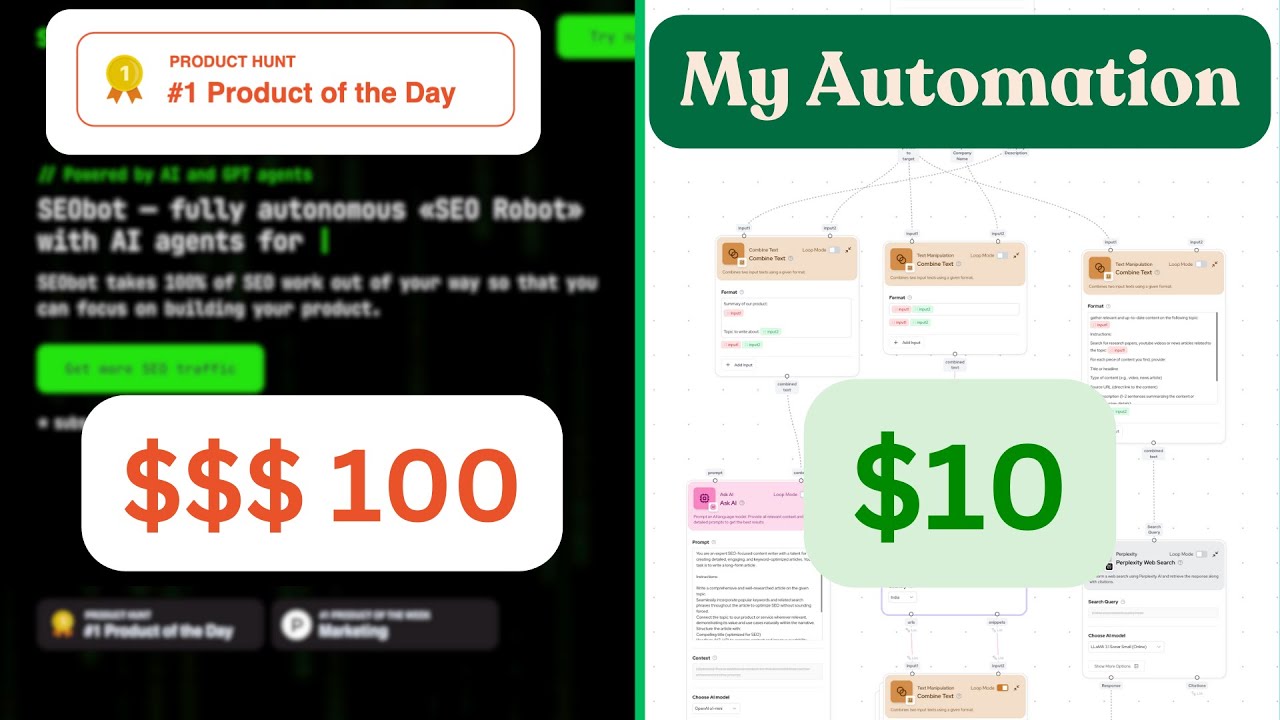
Understanding what AI cannot do is essential for avoiding penalties and wasted effort. Automation is not a set-and-forget magic bullet. One major risk is over-optimization. An AI trained purely on SERP averages might produce content that is technically perfect but flavorless, lacking the unique perspective that Google rewards with the “hidden gems” algorithm update. Your content must retain a human voice and original insights that AI cannot invent from training data.
Another limitation is strategic judgment during algorithm updates. AI models rely on historical patterns. When Google makes a core update that redefines what “helpful content” means, an automated system may continue optimizing for the old paradigm. Human oversight is non-negotiable during these transitions. T You must hard-code ethical boundaries into any automation framework.
Data privacy and factuality pose further challenges. AI models can hallucinate sources, invent statistics, and misinterpret proprietary data if not tightly configured. Never allow AI to publish directly to the web without a human quality check, especially for YMYL (Your Money or Your Life) topics. Trust but verify is the operational mantra.
Comparing AI Automation Tools: All-in-One Platforms vs. Specialized APIs
The market offers two distinct paths. All-in-one platforms like Surfer SEO and MarketMuse combine research, content scoring, and optimization in a single dashboard. They are ideal for teams that want a unified workflow without heavy technical integration. The cost is a lack of deep customization.
For enterprises ready to invest in a tailored stack, API-based solutions like OpenAI’s GPT-4 Turbo, Anthropic’s Claude, and Google’s Gemini allow you to build bespoke automation pipelines. A common advanced setup uses a vector database to store your proprietary content and customer data, which an LLM queries to generate fully informed, brand-accurate drafts. This approach provides maximum control and differentiation but requires development resources.
| Features | All-in-One Platform (e.g., Surfer, Frase) | Custom API Stack (e.g., GPT-4 + Pinecone) |
|---|---|---|
| Ease of Setup | Minutes, no coding required | Days to weeks, needs dev skills |
| Content Uniqueness | Good but can sound templated | Excellent, trained on your data |
| Scalability Cost | Monthly subscription per user | Pay per API token, scales flexibly |
| Automated Technical Audits | Often limited or add-on | Full control via custom scripts + crawling APIs |
| Ongoing Maintenance | Low, handled by vendor | High, requires monitoring and updates |
Common Mistakes When Learning How to Automate SEO with AI
One frequent error is automating everything at once without a clear goal. This leads to fragmented workflows and data overload. Start with one pillar, such as content optimization, map its success metrics, and only then expand to technical SEO. Another costly mistake is ignoring the importance of first-party data. An AI that only sees public competitor data will produce carbon-copy content; feeding it your customer interviews, sales call transcripts, and internal research is what creates a defensible moat.
Many also underestimate the need to recalibrate AI prompts and scoring models. Search intent shifts, and language evolves. A prompt that generated high-converting product descriptions in December may sound stale in March. Schedule a monthly review of all AI outputs to ensure alignment with brand voice and current market language.
Finally, avoid neglecting the technical infrastructure. Automating content at scale without a robust internal linking and caching strategy can slow your site and confuse crawlers. Your AI content engine must be coupled with an SEO-friendly information architecture. Fall in love with the problem of organizing information, not just generating it.
Setting Up an AI Automation Roadmap That Sticks
Success with how to automate SEO with AI demands a phased approach. Phase one should focus on data aggregation: connect your core SEO tools and let AI organize and clean the data. Phase two introduces automated monitoring and alerting, so you no longer check dashboards daily. Phase three deploys AI-assisted content creation with human review. Only after these foundations are solid should you automate technical fixes and outreach.
Document every prompt, every API connection, and every editorial rule. This manual becomes your team’s automation constitution. It preserves institutional knowledge and makes it easy to onboard new members or adjust when an underlying AI model changes. Measure the impact relentlessly—not by volume of content produced, but by organic traffic, engagement metrics, and qualified leads generated. If your automation is not moving these business needles, it is just expensive noise.
Important Notes on Maintaining E-E-A-T in an Automated System
Google’s emphasis on Experience, Expertise, Authoritativeness, and Trustworthiness does not disappear when you introduce AI. In fact, it becomes more critical. Automated content must clearly signal real-world experience. This is achieved by programmatically injecting first-party anecdotes, author bios with genuine credentials, and transparent sourcing. Use AI to highlight where your brand has unique data, and let human editors expand those sections.
Trustworthiness is often compromised when AI generates medical, financial, or legal information without proper review. Implement a rule-based system that flags any YMYL content for mandatory human expert review before publishing. Display clear dates, fact-checker names, and revision histories to demonstrate transparency. Remember, AI can help you prove authority at scale by linking internal research and citing recognized sources, but the ultimate responsibility lies with your editorial team.
Frequently Asked Questions
Can AI completely replace an SEO specialist?
No. AI executes repetitive and pattern-based tasks with remarkable speed, but it lacks the strategic foresight, ethical reasoning, and genuine creativity of an experienced SEO specialist. The most effective SEO teams treat AI as a powerful assistant, not a replacement. Human judgment is still required to interpret nuanced algorithm shifts, craft bold creative angles, and build authentic relationships for link building. The role of the SEO evolves from a doer to an orchestrator and quality controller.
Is AI-generated content penalized by Google?
Google does not penalize content simply because it is AI-generated. The search engine’s guidelines target low-quality, unhelpful content regardless of how it was created. AI-generated content that demonstrates experience, expertise, authoritativeness, and trustworthiness can rank very well, especially when it is reviewed and enhanced by human editors. The risk arises when you use AI to mass-produce thin, duplicated, or factually wrong pages without oversight, which violates spam policies.
How much does it cost to automate SEO with AI?
Costs vary widely depending on the stack. A small business can start with an all-in-one platform for roughly $100 to $300 per month. Mid-sized teams integrating multiple tools and API credits may spend $500 to $2,000 monthly. Enterprise custom solutions using dedicated models, vector databases, and integration development can exceed $5,000 per month. The investment is almost always justified by the labor hours saved and the increased organic traffic generated.
What is the first step to automate SEO for a new website?
Begin with automated technical auditing and keyword opportunity mapping. On a new site, you have no legacy technical debt, so an AI crawler can ensure a flawless foundation from day one. Simultaneously, an AI topic research tool should analyze the entire competitive landscape to build a semantic content map. This map becomes the blueprint for automated content briefs, ensuring every article you produce is part of a coherent topical authority strategy from the very start.
Can AI automate link building without creating spam?
Yes, ethical automation is possible. AI excels at identifying high-quality, relevant prospect sites and drafting hyper-personalized outreach emails that reference specific content on the prospect’s page. The key is to use AI for research and first-draft writing, but maintain a human review step to ensure tone and intention remain authentic. Automating the follow-up sequence is perfectly acceptable; automating unmoderated, templated spam blasts is not and will harm your site.
Conclusion
Mastering how to automate SEO with AI is not about chasing the shiniest tool; it is about redesigning your entire organic growth machine. Start by automating the data-heavy, time-consuming tasks that produce clear ROI: topic clustering, content scoring, technical audits, and performance narrative reporting. Layer in AI-assisted content creation with a robust human review checkpoint. Always keep your automation focused on augmenting human expertise, not sidelining it. The result is a scalable, efficient, and resilient SEO program that continuously adapts to the search landscape. Those who embrace this human-AI partnership will dominate organic channels for years to come, while those who ignore it will find themselves buried under an avalanche of manual work.
Xem thêm:
- AI SEO Intent Optimization: The Complete Guide to Ranking in the Modern Search Era
- How to Generate Meta Tags with AI: Streamline SEO and Boost Click-Through Rates
- AI SEO Image Compression: The Complete Guide to Faster Sites and Higher Rankings in 2025
- Search Generative Experience SEO: How to Optimize for AI-Powered Search and Protect Your Rankings
- AI SEO for Content Teams: The Complete Playbook for 2025
Bài viết cùng chủ đề:

AI SEO SEO Automation with Make: The Complete Workflow Guide

AI SEO SEO Automation with Zapier: The Complete Workflow Guide

AI SEO SEO Automation with n8n: The Complete Workflow Guide
AI SEO SEO Automation with Gemini: The Complete Guide to Scaling Organic Growth

AI SEO SEO Automation with Claude: The Complete Guide to Scaling Content in 2025

AI SEO SEO Automation with ChatGPT: The Complete Playbook for 2025

AI SEO & SEO Automation for Affiliate Sites: The 2025 Playbook for Passive Income Growth
AI SEO & SEO Automation for Bloggers: The Complete Guide to Scaling Your Content

AI SEO & SEO Automation for Agencies: The Complete 2025 Playbook

AI SEO and SEO Automation for Ecommerce: The Complete Playbook for 2025

AI SEO & SEO Automation for WordPress: The Complete Playbook for 2025
AI SEO SEO Automation Strategy: The Complete Playbook for 2025

Mastering the AI SEO SEO Automation Process: A Complete Guide to Scaling Organic Growth
AI SEO SEO Automation System: The Complete Guide to Scaling Organic Growth in 2025
AI SEO SEO Automation Platform: The Complete Guide to Scaling Organic Growth in 2025
AI SEO SEO Automation Software: The Complete Guide to Scaling Organic Growth in 2025















