
No products in the cart.
How to Get Cited by AI: The Definitive Playbook for Generative Search Visibility
29
Jul
Jul
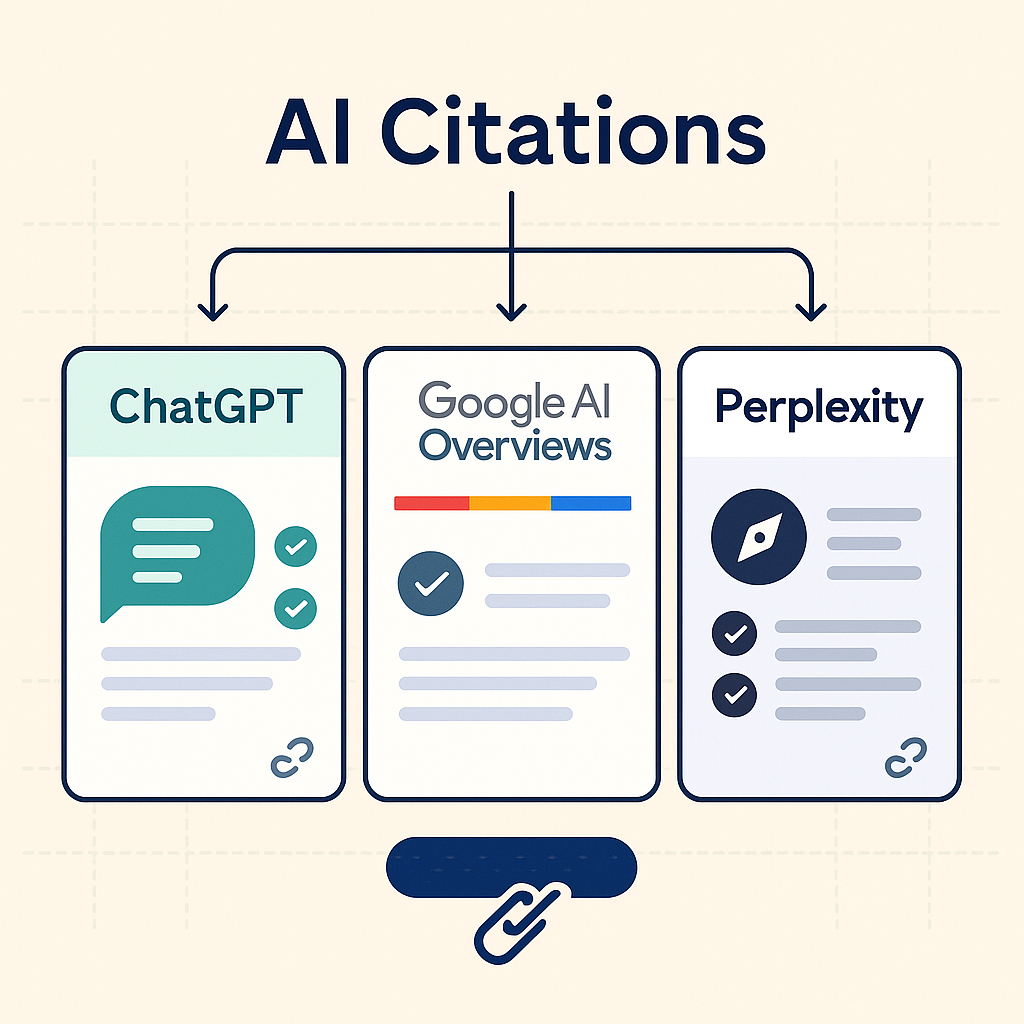
As artificial intelligence reshapes the search landscape, the question on every marketer’s mind is how to get cited by AI. Google’s AI Overviews, ChatGPT’s browsing mode, and a wave of generative engines are rewriting the rules of digital visibility. Getting cited by these systems means your content becomes the answer—not just a blue link. This new reality demands a different optimization playbook, one built on machine-readable authority, crystal-clear structure, and relentless factual accuracy.
What Does It Mean to Get Cited by AI?
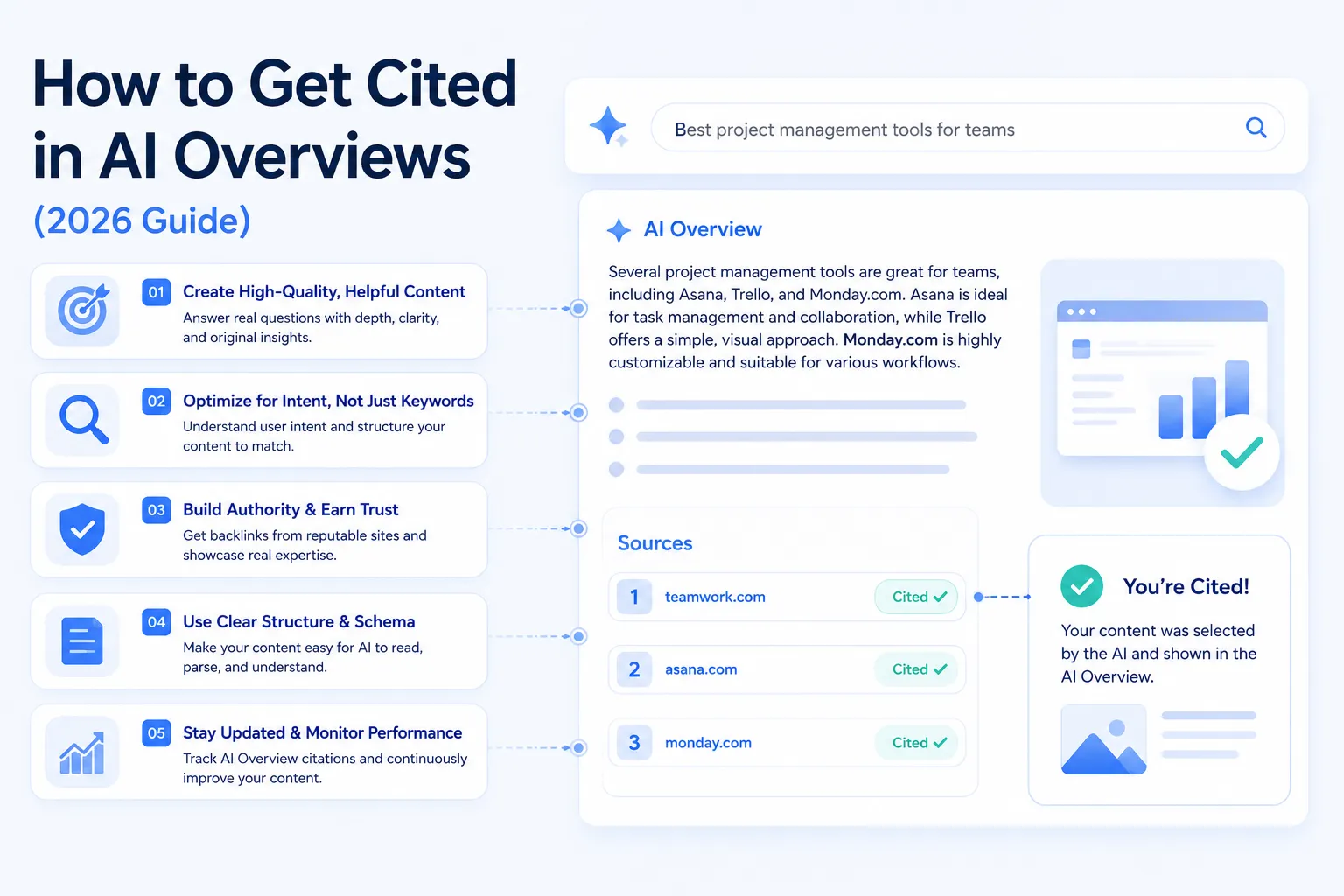
Getting cited by AI occurs when a large language model (LLM) or AI-powered search interface references your website, research, or content as a source in its generated answer. This can take the form of a clickable link inside a Google AI Overview, a numbered citation footnote at the end of a ChatGPT response, or a mention in a Perplexity.ai summary. The technology that enables this is primarily retrieval-augmented generation (RAG), where an AI system pulls real-time information from a trusted index of documents before formulating its response. In some cases, an AI may generate citations based on its static training data, but that output carries no live links and is harder to influence directly.
Unlike traditional organic search, where a page must compete for a click on the SERP, AI citations can propel a brand into a zero-click answer panel that millions of users see without ever visiting the source. The challenge is that the curation logic behind these citations is opaque—models assess authority, factual consistency, structural clarity, and consensus signals to decide which source to surface. Understanding that decision framework is the foundation of any strategy on how to get cited by AI.
Why AI Citations Are Critical for Modern Search Strategy
Gartner predicts that traditional search engine volume will drop by 25% by 2026 due to AI-based answer engines. When users receive a complete, trustworthy answer directly in the search interface or a chatbot, the need to click through to websites plummets. In this environment, being the cited source is the new number-one ranking. It preserves brand visibility and authority even as click-through rates decline.
AI citations also serve as a powerful endorsement signal. When a Google AI Overview highlights a single source for a critical health or finance query, that site instantly inherits an implicit stamp of credibility. For B2B and high-consideration purchases, a citation from Perplexity or a Copilot response can drive highly qualified traffic because the user explicitly asked for vetted information. Beyond traffic, brands that consistently appear as AI citations build a long-term reputation as the definitive voice in their niche, which feeds into both direct visits and traditional search rankings.
The Foundation: Generative Engine Optimization (GEO)

Generative Engine Optimization, or GEO, is the discipline of structuring and enhancing content so that generative AI models select it as a source. While it rests on many pillars of classic SEO—authority, relevance, technical health—GEO adds layers that specifically address how machines consume and cite text. The focus shifts from satisfying a human reader to satisfying an algorithmic reader that scans for direct answers, entity relationships, and citation-worthy signals.
GEO requires you to think about content atomization, semantic closeness to an answer, and provenance markers. A well-optimized page for GEO is one that an LLM can parse as the single most authoritative, succinct, and well-referenced answer to a given query. The table below contrasts traditional SEO with GEO to clarify the evolving mindset.
| Factor | Traditional SEO | Generative Engine Optimization (GEO) |
|---|---|---|
| Primary Goal | Rank in top organic positions for clicks | Become the primary source cited in AI-generated answers |
| Content Structure | Balanced for readability and keyword inclusion | Highly structured with explicit answer blocks, definitions, and fact summaries |
| Authority Signals | Backlinks, Domain Authority, PageRank | Backlinks plus entity anchors in knowledge bases (Wikipedia, Wikidata), E-E-A-T markers, and expert biographies |
| Schema Markup | Used for rich snippets | Essential for machine context; FAQ, HowTo, Article, and QAPage schema drive direct answer extraction |
| Success Metric | Click-through rate, sessions, conversions | Citation frequency in AI outputs, brand visibility in zero-click panels, share of voice in model responses |
How AI Models Select Citations: The Underlying Mechanics
To shape a strategy for how to get cited by AI, you must first understand the retrieval and filtering pipeline. In Google AI Overviews, the system mines the top-ranking organic pages for a query, identifies consensus across authoritative sources, and extracts a synthesized answer with links. A source that contradicts the majority or lacks institutional credibility will be discarded even if it ranks well. Google’s Search Generative Experience heavily relies on E-E-A-T signals and the degree of alignment with the established consensus on truth-sensitive topics.
For retrieval-augmented flows like ChatGPT’s browsing mode or Perplexity, the process involves a search API call, fetching the top handful of documents, and then using an internal ranking model to decide which passages to cite. Research from institutions like Princeton and MIT on “citation-worthiness” reveals that models favor content with clear propositional structure, direct answers within the first paragraph, and attribution to a known entity. Additionally, AI models are often sensitive to recency. A page that updates its data and proudly displays a “last reviewed” date is more likely to be selected than a static article from three years ago, all else being equal.
Training data citations, on the other hand, come from the massive corpora on which models like GPT-4 were pre-trained. If your brand’s research is heavily cited in Common Crawl, Wikipedia, or major news outlets, the model might recall it as fact without linking. While this is extremely difficult to engineer after training, building a pervasive presence in these foundational datasets through PR, open-access research, and Wikidata entries increases the odds that you are treated as ground truth.
Step-by-Step: How to Get Cited by AI in 7 Strategic Moves
1. Build Unshakeable Topical Authority
AI models scan the web for the most authoritative source on a given subject, not just a single page that happens to rank. To become that source, create a dense hub-and-spoke content cluster that covers every subtopic, question, and pain point in your niche. For example, Mayo Clinic does not have one article on diabetes; it has hundreds, all interlinked and consistently updated. This signals to any AI crawler that the domain owns the topic. Combine breadth with depth and ensure your internal linking structure clarifies the parent-child relationships among topics.
2. Create Definitive, Well-Structured Content That Answers Explicit Questions
Write each piece as if it were the final answer to a query an LLM is trying to resolve. Use clear H2 and H3 headings phrased as questions or answer statements. Place a concise, factual answer immediately after the heading, then support it with evidence. Incorporate original statistics, data tables, and direct quotes from recognized experts. Bullet points and ordered lists help the AI extract a clean answer. For example, if you want to be cited for “how to get cited by AI,” your H2 could be “What Signals Do AI Models Look For in a Citable Source?” and the first sentence should be: “AI models look for authority, factual consistency, entity backing, structured answers, and recent updates.” This format mirrors the extraction templates many RAG systems use.
3. Establish E-E-A-T at a Structural Level
Experience, Expertise, Authoritativeness, and Trustworthiness are not just soft signals—they are hard requirements for AI citation, especially in Your Money or Your Life (YMYL) topics. Every article on your site should display a visible author box with verifiable credentials, a link to a full bio, and a publication date. Your About page must detail who runs the organization and what qualifies you. Back up claims with citations to peer-reviewed studies, official sources, or original data. A clear privacy policy, physical address, and HTTPS security further cement trust. Google’s quality rater guidelines explicitly influence how its search and AI systems evaluate sources, and similar heuristics are increasingly adopted by other answer engines.
4. Get Cited in Authoritative Knowledge Bases
Many AI models, including those powering search, tap into structured knowledge repositories like Wikipedia, Wikidata, DBpedia, and IMDb to verify entity facts. Securing a Wikipedia article for your brand or key executives is a powerful gateway—but it must be earned through notability, not self-promotion. Alternatively, injecting your organization’s structured data into Wikidata ensures that when an AI seeks a reliable fact about your entity, the machine finds an authoritative, machine-readable record. Supplement this with mentions in trusted media outlets,.edu resources, and government databases. Each external validation strengthens your entity’s graph, making it more likely to be the fallback citation.
5. Optimize for Retrieval-Augmented Generation (RAG) Readiness
RAG systems break documents into chunks and retrieve the most relevant chunk for a query. To maximize your content’s chance of being that chunk, segment your pages into self-contained, semantically complete sections. Use semantic HTML5 elements like <article>, <section>, and clear heading hierarchies so the parser can accurately identify boundaries. Avoid burying key facts in complex carousels, image-rendered text, or JavaScript-powered expandable sections. Each section should stand alone with a topic sentence, supporting detail, and a mini-conclusion. Think of it as creating micro-articles within a long-form page. Clean, crawlable URLs, a logical XML sitemap, and fast server response times make retrieval effortless for the AI’s fetcher.
6. Regularly Update and Fact-Check Your Content
Freshness is a ranking factor for AI citations, particularly for queries with temporal intent. An article from 2021 will rarely be chosen over an identical piece refreshed in 2024 with updated statistics. Implement a routine content audit cycle, and prominently display the “Last Updated” date. When you revise a page, add a note explaining the changes to help crawlers recognize the refresh. For highly dynamic fields like technology or health, set a maximum lifespan of 6 months before a thorough review. AI systems want to cite information that reflects the current state of the world, so think of content as a living asset that must earn its citation repeatedly.
7. Adopt Structured Data and Entity Markup
Schema.org markup turns an ordinary web page into a machine-readable knowledge card. For AI citation, the most impactful types are Article, Organization, Person, FAQ, HowTo, and QAPage. Applying FAQ schema tells the engine that a section contains question-answer pairs it can lift verbatim. Organization schema connects your site to your official social profiles and Knowledge Graph entry, reinforcing entity identity. When you tag your experts with Person schema linked to their Orcid or Google Scholar, you provide an authoritative chain that models can trust. Even advanced schema, like ClaimReview for fact-checked statements, can signal to AI that your content has been externally validated, increasing citation likelihood.
Common Mistakes That Prevent AI Citations
Many sites that perform well in traditional rankings fail to secure AI citations because they overlook machine-readability and authority depth. Avoid these frequent pitfalls:
- Thin content without original insights. A page that merely rephrases the top 10 SERP results adds no new signal; A
- Keyword stuffing and unnatural language. Over-optimized text degrades the clarity that AI models need to extract a clean answer. Write for accuracy first, with keywords integrated naturally.
- Anonymous or unverified authorship. A page without an author bio, or with a generic pen name, lacks the E-E-A-T signals that AI systems require to trust the content, especially on sensitive topics.
- Ignoring structured data. Neglecting schema markup is leaving the AI blindfolded. Machines cannot infer context as easily as humans; clear labels are non-negotiable.
- Duplicate or aggregated content. AI models filter out duplicate signals; if your article is syndicated without canonical tags, it may be treated as noise and never cited.
- Slow, inaccessible architecture. The AI fetcher needs to download and parse your page in milliseconds. Bloated scripts and server errors will cause it to move to the next candidate.
Monitoring and Measuring AI Citations
Unlike Google Search Console, t You must cobble together a measurement framework using multiple tools and manual checks. For Google AI Overviews, tools like Semrush and ZipTie.dev can now track whether your site appears in the carousel of sources within an AI-generated panel. Ahrefs and Similarweb report emerging “AI overviews” as a traffic source segment in their analytics, albeit with limited granularity.
For ChatGPT and other chatbots, schedule regular prompt audits: craft the 20 most relevant queries for your niche, ask the model to “cite your sources” while browsing, and record whether your domain appears. Automated monitoring platforms like Brand24 or Talkwalker can catch brand mentions even in AI outputs scraped from social media or forums. Additionally, set up Google Alerts for phrases like “according to [YourSite]” coupled with “AI” to flag organic citations. Over time, build your own internal benchmark for citation share of voice and correlate it with brand search spikes and direct traffic trends.
Frequently Asked Questions
Can I manually request an AI to cite my website?
T AI systems select sources based on algorithmic assessments of authority, relevance, and trustworthiness. You cannot pay for citation placement or request inclusion. All you can do is optimize your content to meet the selection criteria, just as with organic search.
Does being cited by AI guarantee increased website traffic?
Not always directly. Many AI-generated answers satisfy the user’s query without needing a click. However, being the cited source builds brand equity, can lead to more branded searches, and protects your visibility in an era where traditional clicks are diminishing. Some users do click through to verify the source, especially for complex or high-stakes questions, so citations can still drive highly qualified traffic.
How long does it take to get cited by AI?
T If your domain already has strong authority and you publish a remarkable, well-structured piece, it could be cited within days if the AI system’s retrieval layer picks it up. More commonly, building the necessary entity authority, backlink profile, and topical depth takes several months. Think of AI citation as a long-term byproduct of becoming a known authority, not a quick win.
Does AI cite paywalled or gated content?
Rarely, if ever, in retrieval-augmented generation. The AI fetcher needs open access to read and extract content. A hard paywall blocks the crawler entirely. Soft gate content with a teaser might be partially indexed, but the core facts usually remain hidden. For training-data citations, the model may have been trained on gated content that was illegally scraped or shared, but responsible developers are working to filter such sources. If you want to be cited, ensure your key facts are publicly accessible.
What types of content are most likely to get cited by AI?
Original research reports, data compilations, official documentation, consensus-backed definitional content, and meticulously structured how-to guides top the list. AI models gravitate toward sources that reduce subjective interpretation—objective facts, statistics, step-by-step procedures, and clear statements of truth are favored. Content that directly addresses “what is,” “how to,” or “what are the statistics on” with crisp, verifiable answers is a prime candidate.
Conclusion
Learning how to get cited by AI is not a one-time tactic but a continuous commitment to being the most reliable, machine-friendly source in your field. The principles are simple but demanding: build deep topical authority, craft content that serves as a definitive answer, reinforce your credibility with verifiable E-E-A-T signals, and encode everything with structured data so that machines can read your expertise as clearly as humans do. As generative search becomes the default interface, the brands that will thrive are those that stop chasing clicks alone and start engineering citations. Every update, every schema tag, and every expert insight you publish inches your content closer to being the answer AI cannot afford to leave out.
Xem thêm:
- AI SEO Personalization: The Complete Guide to Hyper-Relevant Search Rankings in 2025
- AI Landing Page Optimization: Transform Your Conversion Rates with Smart Technology
- AI SEO AI Search Audit: The Complete Guide to Future-Proofing Your Rankings
- AI SEO Broken Link Opportunities: The Complete Guide to Automated Link Recovery
- AI Visual Search SEO: A Complete Guide to Ranking Images in the Visual Discovery Era
Bài viết cùng chủ đề:

AI SEO SEO Automation with Make: The Complete Workflow Guide

AI SEO SEO Automation with Zapier: The Complete Workflow Guide

AI SEO SEO Automation with n8n: The Complete Workflow Guide
AI SEO SEO Automation with Gemini: The Complete Guide to Scaling Organic Growth

AI SEO SEO Automation with Claude: The Complete Guide to Scaling Content in 2025

AI SEO SEO Automation with ChatGPT: The Complete Playbook for 2025

AI SEO & SEO Automation for Affiliate Sites: The 2025 Playbook for Passive Income Growth
AI SEO & SEO Automation for Bloggers: The Complete Guide to Scaling Your Content

AI SEO & SEO Automation for Agencies: The Complete 2025 Playbook

AI SEO and SEO Automation for Ecommerce: The Complete Playbook for 2025

AI SEO & SEO Automation for WordPress: The Complete Playbook for 2025
AI SEO SEO Automation Strategy: The Complete Playbook for 2025

Mastering the AI SEO SEO Automation Process: A Complete Guide to Scaling Organic Growth
AI SEO SEO Automation System: The Complete Guide to Scaling Organic Growth in 2025
AI SEO SEO Automation Platform: The Complete Guide to Scaling Organic Growth in 2025
AI SEO SEO Automation Software: The Complete Guide to Scaling Organic Growth in 2025















