
No products in the cart.
Perplexity vs Google Search: Which One Truly Understands Your Questions in 2025?
29
Jul
Jul
The way billions of people find information is undergoing the most radical shift since the launch of PageRank. Search engines are no longer just link aggregators; they are becoming conversational answer machines. At the heart of this transformation sits a heated debate: Perplexity vs Google Search. One is a legacy titan processing over 8.5 billion queries a day, while the other is a fiercely independent AI-native startup reimagining what a search engine should be. This comparison goes far beyond just technology. It touches on accuracy, user experience, intellectual honesty, and the future of how we consume knowledge.
If you have ever wasted ten minutes clicking through blue links and reading SEO-fluff, or if you have been burned by an AI-generated hallucination dressed up as fact, understanding the deep differences between these two platforms is essential. This article breaks down their core architectures, real-world performance, and hidden limitations so you can decide which tool fits your specific need for speed, depth, or absolute truth.
What Is Perplexity AI? An Answer Engine, Not Just a Search Box
Perplexity is often miscategorized as a simple search engine. It is more accurately described as an answer engine or a conversational research assistant. It does not just retrieve a list of web pages; it reads and synthesizes them. When you ask a query, Perplexity’s own language models (often fine-tuned on models like GPT-4, Claude, or their proprietary Sonar models) perform real-time browsing. It reads multiple sources concurrently, extracts relevant text, and fuses that information into a cohesive, structured answer with direct inline citations.
The ground truth of Perplexity lies in its commitment to provenance. Every factual claim is backed by a numbered source link pinned at the top of the interface. It operates on a freemium model, with Pro subscribers unlocking advanced reasoning models and unlimited “Pro Search” queries that dive deeper with follow-up clarification questions. This architecture fundamentally shifts the labor from the user (reading and filtering) to the machine (analyzing and compiling).
How Google Search Has Evolved into a Hybrid AI Giant
Google Search is not standing still. For decades, its core mission was “organizing the world’s information” via a complex ranking algorithm of crawling, indexing, and link-analysis. In 2024 and 2025, Google aggressively rolled out the Search Generative Experience (SGE), now fully integrated as “AI Overviews.” This feature places a synthesized AI snapshot at the top of the results page, above the traditional 10 blue links.
However, Google’s foundation remains fundamentally different. It is an index of the web’s pages first, and an AI summarizer second. The AI Overviews pull from the same index, but the user still retains the vast ecosystem of Knowledge Panels, Maps, Shopping, and rich snippets. Google’s massive advantage is its multi-modal integration and the sheer scale of its real-time data, but this also creates structural friction: the AI must summarize content that the same company’s algorithm originally ranked, which can introduce circular biases.
Core Architecture: Retrieval Methods Under the Microscope
The clash in the Perplexity vs Google Search war is essentially a clash between retrieval-augmented generation (RAG) and hybrid index-ranking. Understanding their guts explains why they fail at different tasks.
Google’s Index-First, AI-Second Pipeline
- Massive Crawling Infrastructure: Google maintains the most comprehensive index of the web, refreshed in near-real time for news. Its crawlers are always scanning.
- Ranking Signals: It evaluates authority, backlinks, mobile usability, and user click data to sort the list.
- AI Overlay: The AI Overviews model is called in at query time only if Google’s classifiers deem it useful. If the query is commercial or transactional, the AI summary might be suppressed to favor ads and direct shopping links.
- Personalization Bucket: Search results are deeply personalized based on your history, location, and ad profile.
- Query Decomposition: Complex questions are broken into multiple targeted sub-searches.
- Parallel Fetching: It hits search APIs (often Bing’s backend) to grab the top pages, then scrapes the full text of those pages.
- Contextual Filtering: A large language model discards irrelevant chunks and rewrites them into a flowing answer using only the fetched data.
- Transparency Layer: The system forces a strict mapping between output sentences and the input URLs, drastically reducing unsupported hallucinations.
Perplexity’s Agentic Retrieval-Aware Loop
Perplexity vs Google Search: Head-to-Head Accuracy and Citation
Accuracy is where the philosophical split becomes a practical nightmare or a massive win. Google’s AI Overviews have famously generated dangerous advice, such as suggesting users add glue to pizza to keep cheese sticking, based on satirical Reddit posts that ranked high in its index. Because Google’s AI weights high-ranking pages heavily, it can be tricked by SEO manipulation and sarcasm if the guardrails fail.
Perplexity, conversely, employs an agentic search that often filters out obvious noise, but it struggles with temporal freshness if the underlying search API does not prioritize the latest breaking news. Both can hallucinate. However, the citation granularity in Perplexity makes fact-checking instantaneous. You can hover over a claim to see the exact source snippet. Google’s AI Overviews sometimes provide carousel-style links that are not directly mapped to the specific sentence, making verification clunky.
The Hallucination Factor
A falsehood from Google SGE can destroy trust because the user assumes the vast index vetted it. A falsehood from Perplexity is easier to spot because its answer is usually shorter and every claim is a hyperlink. In stress tests involving very recent news (less than 15 minutes old), Google’s real-time index often provides a raw link faster, while Perplexity may display outdated information cached in its search backend. In high-stakes legal or medical research, Perplexity’s ability to handle file uploads (PDFs) and conduct “Deep Research” with hundreds of queries gives it a qualitative edge for synthesis over Google’s snippet-style overview.
User Experience and Interface Philosophy
The interface difference is stark. Google Search offers the “unbundled” experience: dozens of navigation points, images, people-also-ask modules, ads, and map packs. It targets high-choice satisfaction, where the user is expected to browse. Perplexity offers the “bundled” experience: a clean, minimal chat interface with a single, well-formatted answer. It targets zero-navigation satisfaction, where the user reads and exits.
This distinction is central to the Perplexity vs Google Search productivity debate. For a complex research query—”Explain how the carry trade unwind caused the Japanese market crash in August 2024″—Google will show you six news outlets. You must read each, compare the narratives, and synthesize the timeline yourself. Perplexity will generate a multi-paragraph timeline citing Bloomberg, Nikkei, and Reuters, strung together logically. The time-to-insight is reduced from minutes to seconds for Perplexity, but you cede the ability to easily browse secondary adjacent opinions.
Proactive vs. Reactive Search
With Google Discover and its home screen feed, Google is a proactive push platform based on interests. Perplexity is a strictly reactive pull platform, responding only to a user query (though its Discover feature is now growing). If you want serendipitous news discovery without asking a question, Google remains far superior.
Privacy and Advertising: The Core Business Model Clash
Privacy is a non-negotiable differentiator. Google Search is the core revenue driver of Alphabet, generating over $175 billion annually primarily through targeted advertising. A search for “best running shoes” triggers a complex real-time auction for your eyeballs, leveraging location, demographics, and browsing behavior stored in your profile. Google’s entire AI evolution, including SGE, is being carefully designed to preserve and enhance ad placement, though AI answers can shrink the organic click-through rate for publishers.
Perplexity operates on a subscription-revenue model (Perplexity Pro) and has publicly pledged not to use user data for ad targeting in a traditional sense (though it may introduce ads in the future). Currently, the “AI” is not biasing results toward a paying merchant. This means a product query on Perplexity returns aggregation based on review consensus, not the highest ad bid. For sensitive queries—health, finance, or political research—Perplexity offers a cleaner, less distorted lens because the financial incentive is aligned with user satisfaction, not advertiser demand.
Content Ecosystem and Publisher Relationships
The relationship with publishers is a significant source of tension in comparing these tools. Google’s model, while often criticized for “zero-click” theft, still sends billions of visits to publishers. The blue-link model, however dented by AI Overviews, maintains a direct pipeline to the source website.
Perplexity has faced fierce criticism from The New York Times and Forbes for summarizing paywalled content and not driving sufficient referral traffic. A detailed report by Wired suggested Perplexity’s bot sometimes scrapes content despite robot.txt restrictions. However, Perplexity’s newly launched “Publishers’ Program” shares subscription revenue with partners. The ethical dilemma is stark: Google generates ad revenue that indirectly funds journalism, while Perplexity compresses that journalism into a single answer, risking the economic viability of the sources it relies on. If the web loses its quality sources due to Perplexity’s disruption, both Google and Perplexity will have less accurate ground truth to crawl.
Practical Application: Which Tool Wins for Specific Tasks?
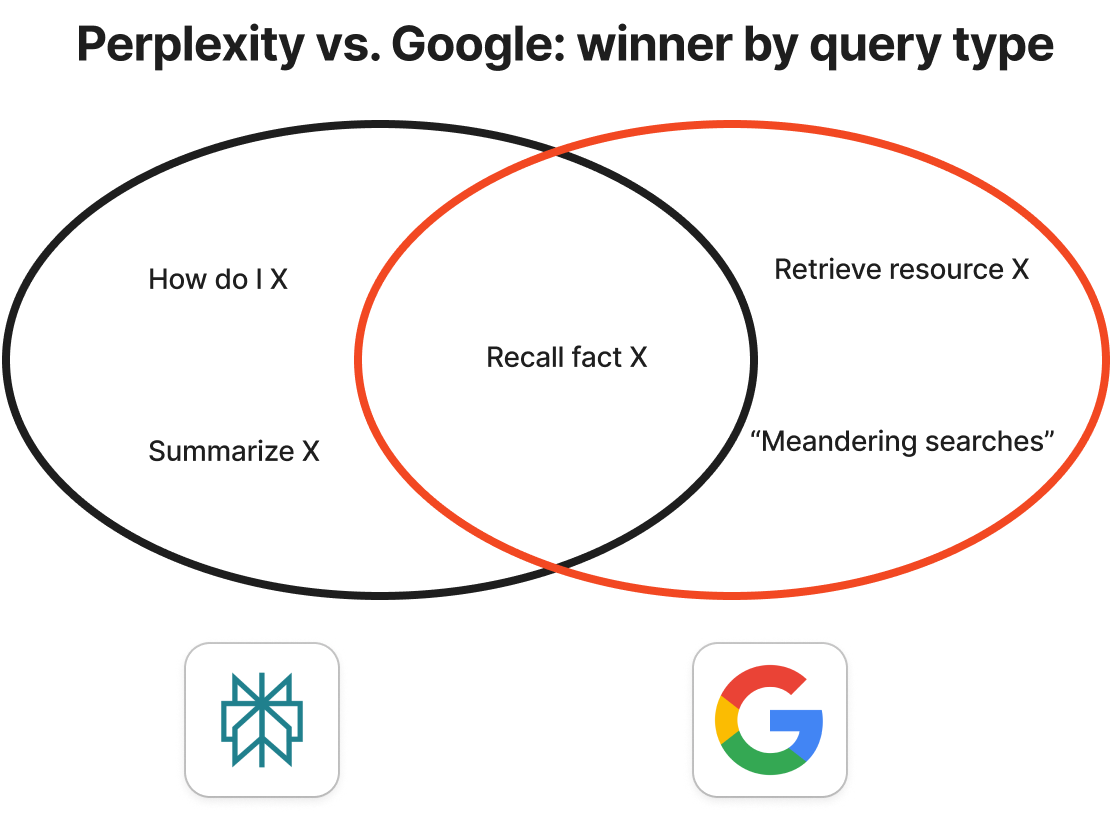
To master the Perplexity vs Google Search dynamic, you must match the tool to the task. Using the wrong tool is a massive drain on productivity.
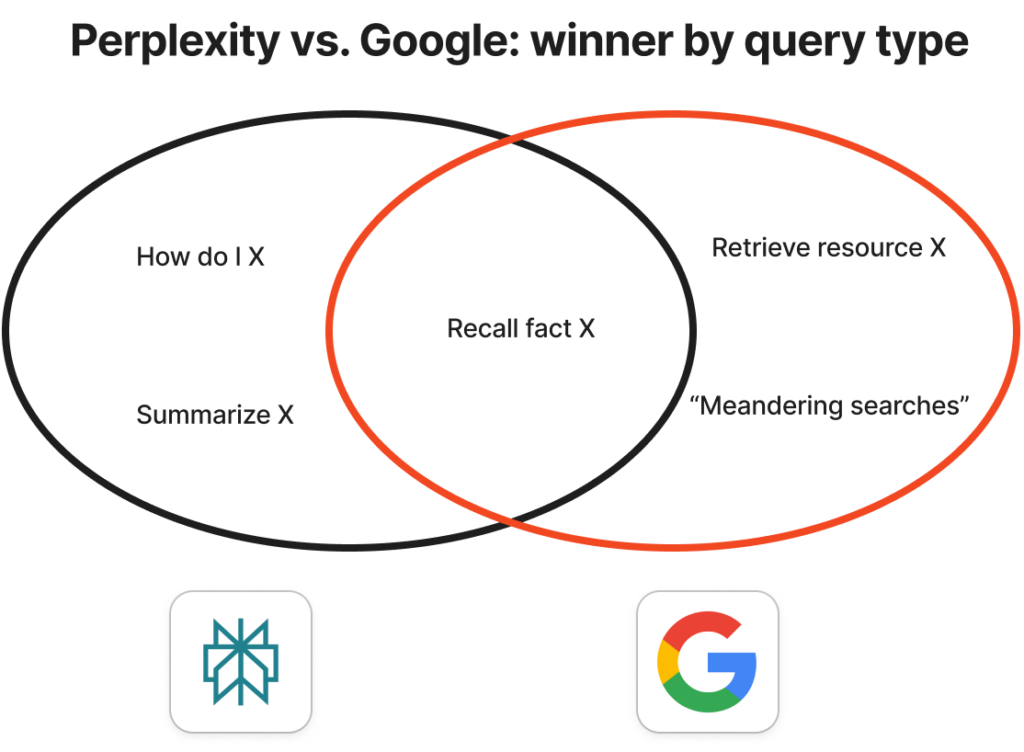
| Task | Winner | Reason |
|---|---|---|
| Real-time breaking news (under 10 min) | Google Search | Superior real-time indexing; Twitter/X integration and live refresh beats Perplexity’s API fetch delay. |
| Complex academic research synthesis | Perplexity (Pro) | Deep Research mode handles hundreds of queries; direct PDF upload and long-context summarization. |
| Local business discovery (restaurants, plumbers) | Google Search | Unmatched Maps integration, reviews, hours, traffic. Perplexity’s local data is still generic. |
| Product comparison (non-sponsored) | Perplexity | Ad-free aggregation of Reddit, Specs, and reviews into a clean comparison table. Google’s top results are heavy on affiliate and ad clutter. |
| Fact-checking a claim | Perplexity | The “Can I verify this now?” test: inline, mapped citations provide a faster audit trail than scanning Google snippets. |
| Transactional shopping with coupons | Google Search | Direct Shopping tab, promo codes, and trust signals for payments. Perplexity does not handle checkout flows. |
Common Mistakes and How to Avoid Them
1. Treating Perplexity Output as a Primary Source
The most dangerous mistake is confusing the cited summary for the original source. Even with rigorous citations, Perplexity can misparaphrase, drop critical context, or show a contradictory abstract. Always click through to the actual paper, article, or database to confirm. Use the “View Sources” button as a portal, not a guarantee.
2. Using Google SGE for Medical or Legal Advice
AI Overviews attempt to synthesize medical information but often flatten nuanced, conflicting studies into a single misleading sentence. If Google merges old clinical guidelines with new speculative trials, the advice becomes clinically dangerous. In white-collar professional domains, switch off the AI mental shortcut and manually vet the primary domain experts listed in the organic links.
3. Ignoring the “Focus” Mode on Perplexity
Users frequently paste a broad query into the default “Web” mode when they should specify “Academic” or “Social.” Asking Perplexity for an academic paper in Web mode often returns blog summaries. Changing the Focus filter forces the AI to restrict its source pool to peer-reviewed journals or Reddit communities, respectively, drastically sharpening output quality.
4. Forgetting Google’s Personalization Bubble
When doing objective research on Google, not using an incognito window or turning off search personalization (available in Labs settings) leads to heavily biased political or consumer results. Google often tells you what it thinks you want to hear, whereas Perplexity, using a set seed of retrieval, gives a more uniform aggregate of the web’s mainstream consensus.
Important Notes on Data Freshness and Latency
Perplexity does not crawl the live web in the same way Googlebot does. It relies significantly on search indexes from Bing and its own crawler (PerplexityBot). For queries requiring split-second updates—like sports scores as a goal is scored, or seismic shifts in stock prices—Google’s “Live” tab and instant query understanding remain unbeatable. Conversely, Google’s AI Overview latency can sometimes be slow to generate, making the classic blue link faster than waiting for an unneeded AI summary. Savvy researchers often disable AI Overviews via browser extensions to reclaim speed when they know they just need a link.
Frequently Asked Questions
Can Perplexity AI completely replace Google Search in 2025?
Not entirely. Perplexity excels at deep research, synthesis, and neutral aggregation, but it lacks Google’s massive physical infrastructure for local maps, real-time transportation alerts, and the long-tail commercial inventory that dominates e-commerce. For daily utility like driving directions or nearby coffee shop ratings, Google retains a massive edge. The ideal modern workflow is a bimodal search habit: use Perplexity for “learning and understanding” tasks, and Google for “doing and navigating” tasks.
Does Perplexity give more accurate answers than Google’s AI Overviews?
In controlled, long-tail informational queries, Perplexity tends to produce fewer detached hallucinations because its output is tightly chained to the retrieved text. Google’s AI Overviews have a broader knowledge base but are more susceptible to ranking manipulation and satirical content. However, both can be wrong; Perplexity is simply easier to audit because the citations are sentence-level and transparent, while Google’s sourcing is often aggregated in a floating link cluster.
Is my search history safer on Perplexity than on Google?
From a privacy-architecture standpoint, yes. Google’s primary business model is behavioral advertising, meaning your search history is processed for profit. Perplexity currently monetizes via subscriptions and does not build a cross-platform advertising profile on you (though it stores query log data to improve service). For sensitive research where you do not want your identity attached to a query pattern, Perplexity offers a less invasive environment, provided you trust its data-handling policy.
Why does Perplexity sometimes show outdated information?
Perplexity relies on a retrieval layer that may cache search results briefly to minimize latency and API costs. If a story breaks within the last hour, Perplexity’s default Web mode might query an index that hasn’t yet ingested the latest articles. Google’s continuous, headline-first crawling gives it a freshness advantage in breaking news scenarios.
Which tool is better for academic research with uploaded papers?
Perplexity Pro is vastly superior. You can upload a dense PDF and ask cross-document questions. The “Spaces” feature allows you to build a persistent knowledge base from multiple papers. Google’s NotebookLM offers a similar “upload and ask” but is a separate product. Perplexity merges this deep-document reasoning with the ability to simultaneously search the live internet for related studies in a single context window.
Conclusion
The Perplexity vs Google Search duel is not about a winner-takes-all outcome. It is a divergence of search philosophy. Google remains the undisputed digital infrastructure for navigating the physical and transactional world—a universal directory with an AI assistant bolted on. Perplexity represents the agentic layer of the information age: a cognitive tool that acts as a filter against the noise, prioritizing source-aware synthesis over algorithmic rabbit holes.
For the discerning knowledge worker, journalist, developer, or student in 2025, the question is not which one to use, but when. Use Google when you need to act—buy a ticket, find a route, check a score. Use Perplexity when you need to think—understand a complex topic, map a debate, or draft a research brief. As Google extends its grasp with Gemini, and as Perplexity builds out its trust network with publishers, the search landscape will likely converge into a hybrid where human curiosity is guided by machines, but intellectual sovereignty is preserved only when we use the right machine for the right question.
Xem thêm:
- AI SEO Automated SEO Reports: The Complete Guide to Smarter Reporting in 2025
- Gemini SEO: Mastering Search Optimization in Google’s AI-First Era
- Unlock Endless Authentic Feedback: A Deep Dive Into the AI Review Generator
- AI SEO Informational Intent: The Complete Guide to Winning Search Visibility
- AI Content Planner: Revolutionize Your Content Strategy with Intelligent Automation
Bài viết cùng chủ đề:

AI SEO SEO Automation with Make: The Complete Workflow Guide

AI SEO SEO Automation with Zapier: The Complete Workflow Guide

AI SEO SEO Automation with n8n: The Complete Workflow Guide
AI SEO SEO Automation with Gemini: The Complete Guide to Scaling Organic Growth

AI SEO SEO Automation with Claude: The Complete Guide to Scaling Content in 2025

AI SEO SEO Automation with ChatGPT: The Complete Playbook for 2025

AI SEO & SEO Automation for Affiliate Sites: The 2025 Playbook for Passive Income Growth
AI SEO & SEO Automation for Bloggers: The Complete Guide to Scaling Your Content

AI SEO & SEO Automation for Agencies: The Complete 2025 Playbook

AI SEO and SEO Automation for Ecommerce: The Complete Playbook for 2025

AI SEO & SEO Automation for WordPress: The Complete Playbook for 2025
AI SEO SEO Automation Strategy: The Complete Playbook for 2025

Mastering the AI SEO SEO Automation Process: A Complete Guide to Scaling Organic Growth
AI SEO SEO Automation System: The Complete Guide to Scaling Organic Growth in 2025
AI SEO SEO Automation Platform: The Complete Guide to Scaling Organic Growth in 2025
AI SEO SEO Automation Software: The Complete Guide to Scaling Organic Growth in 2025















